


17, Oct 2023
Unlock the Power of SEO for B2B Companies: A Complete Guide

Are you a B2B company struggling to harness the full potential of search engine optimization (SEO)? Look no further; we’ve got the key to unlocking your online success!
In today’s digital era, SEO for B2B companies has become an indispensable tool for businesses, but B2B companies face unique challenges that require tailored strategies. From reaching niche audiences to driving relevant traffic, this blog post will delve into the world of SEO for B2B companies.
Get ready to conquer those obstacles and propel your business towards new heights with our expert tips and insights. Let’s unlock the power of SEO together!
Introduction to SEO and B2B Companies
As the world of digital marketing continues to evolve, so too has the landscape of search engine optimization (SEO). For business-to-business (B2B) companies, this can pose unique challenges. After all, B2B companies are often selling products or services that are complex, expensive, and not necessarily purchased by individual consumers.
But despite these challenges, SEO can be a powerful tool for B2B companies, helping them to attract qualified leads, close more sales, and grow their business. In this article, we’ll take a look at some of the unique challenges faced by B2B companies when it comes to SEO, as well as how they can overcome them.
One common challenge faced by B2B companies is that their website visitors are often in the “research” phase of the buying cycle, meaning they’re not yet ready to make a purchase. This can make it difficult to generate leads and sales from your website. However, there are a few things you can do to overcome this challenge.
First, focus on creating high-quality content that will help your website visitors in their research process. This could include blog posts, white papers, eBooks, infographics, and more. Make sure your content is well-researched and provides value to your audience.
Second, use effective calls-to-action (CTAs) throughout your website to encourage your visitors to take the next step in the buying cycle. You may also want to consider setting up lead magnets, such as free consultations or email newsletters, to capture more leads.
Finally, use SEO tactics such as keyword research and link building to help your content rank higher in search engine results pages (SERPs). This will ensure that your content reaches a larger audience and can generate more leads and sales for your B2B company.
Challenges of SEO for B2B Companies
The challenges of SEO for B2B companies are numerous and varied. Perhaps the most significant challenge is that B2B companies tend to be much more complex than their B2C counterparts. This means that there are more potential variables to consider when optimizing a website for search engines.
Another common challenge is that B2B buyers are often more sophisticated and informed than B2C buyers. This means that they may be less likely to respond to traditional SEO tactics like keyword stuffing or link buying. Instead, they may be more interested in content that is truly informative and helpful.
B2B companies often have very niche products or services. This can make it difficult to rank for broad keywords since there is so much competition. Instead, B2B SEO practitioners need to focus on long-tail keywords that are specific to their product or service.
Solutions to Common Challenges
1) Lack of Understanding: One of the biggest challenges is that many business owners simply don’t understand how SEO works or why it’s important. The solution is education. Make sure you take the time to explain the basics of SEO and its importance to your clients.
2) Limited Resources: Many small businesses have limited resources, which can make it difficult to invest in SEO. The solution is to focus on low-hanging fruit and free traffic sources first, such as local directories and social media. Once you start seeing results from these efforts, you can then reinvest those savings into more advanced SEO tactics.
3) Competitive Landscape: The competitive landscape can be tough for BB companies, especially if they’re in a highly competitive industry. The solution is to focus on long-tail keywords and niche markets where there’s less competition. You can also use other marketing channels to supplement your SEO efforts and help you stand out from the crowd.
4) Poor Website Quality: A common challenge for BB companies is having a poor-quality website that doesn’t convert visitors into customers. The solution is to invest in website design and development services that will help improve your site’s overall quality and usability. Additionally, make sure your website content is well-written and optimized for search engines.
5) Bad Link Building Tactics: Link building is an important part of SEO, but it’s also one of the most difficult tasks to get right. The solution here is to focus on quality over quantity when it comes to link building. Try to build relationships with other websites in your niche, as well as use content marketing tactics like guest blogging and infographics.
Ranking Factors That Affect SEO Performance
1. Relevance
One of the most important ranking factors that affects SEO performance is relevance. This means that your website and its content must be relevant to the keywords you are targeting. If your website is about selling widgets, then your content should be about selling widgets. If you are targeting the keyword “widget,” then your website should be about widgets.
2. Authority
Another important ranking factor is authority. This refers to how well-known and respected your website is in the eyes of search engines. If you have a lot of backlinks from high-quality websites, then you will likely have a higher authority than a website with fewer backlinks.
3. Content Quality
The third-ranking factor is content quality. This refers to how well-written and informative your content is. If your content is full of typos and grammar errors, then it will likely not rank as well as content that is well-written and free of errors.
4. User Experience
The fourth ranking factor is user experience. This refers to how easy it is for users to find what they are looking for on your website and navigate around your site. If your website is difficult to use or navigate, then users will likely leave quickly, which will hurt your SEO performance.
5. Technical SEO
Finally, technical SEO is another important ranking factor. This refers to how well your website is optimized for search engines. If you have broken links or outdated code on your website, then it will not rank as well as a website with updated code and optimized links.
Content Strategy of SEO for B2B Companies
B2B companies have unique challenges when it comes to SEO. They must overcome the hurdle of getting their content found and ranking high in search results, while also ensuring that their content is relevant and targeted to their audience.
An effective B2B SEO strategy must take into account the different goals and challenges that these companies face. By understanding these challenges and crafting a customized strategy, B2B companies can unlock the true power of SEO and use it to their advantage.
Link-building Strategies of SEO for B2B Companies
B2B companies face unique challenges when it comes to SEO and link building. Here are some strategies for overcoming these challenges:
1. Use keyword-rich anchor text. Anchor text is the text that appears on a web page that links to another web page. When building links, use keywords in your anchor text to help improve your site’s search engine rankings.
2. Get listed in online directories: Online directories can be a great way to build links to your website. Make sure to choose relevant, high-quality directories that will give you good exposure.
3. Create informative content: Informative content is one of the best ways to earn natural links from other websites. Write helpful blog posts, whitepapers, eBooks, and more to attract attention from other businesses in your industry.
4. Reach out to influencers: Influencers are people with a large following who can help promote your website and content. Connect with influencers in your industry and ask them to share your content with their followers.
5. Participate in forums and discussion boards: Forums and discussion boards are great places to interact with potential customers and build links back to your website. Make sure you’re providing valuable insights and not just self-promoting if you want to gain trust and earn links from these sources.
6. Connect with other businesses: Reach out to other businesses in your industry and ask for link exchanges. This can be a great way to build links, as long as the sites you’re exchanging links with are related to your business and industry.
7. Use social media platforms: Social media platforms such as Twitter, Facebook, and LinkedIn are great ways to share content and build relationships with potential customers and link partners. Make sure to post quality content regularly that your followers will want to share and link back to.
Measurement and ROI of SEO for B2B companies Efforts
BB companies have unique challenges when it comes to SEO. They often lack the resources and budget to invest in SEO, and they also have to contend with a smaller customer base. However, SEO can be a powerful tool for BB companies if used correctly.
There are a few key things to keep in mind when measuring the ROI of SEO efforts:
1. Set realistic goals. Don’t try to rank for keywords that are too competitive or unrealistic. Focus on more attainable goals, such as ranking for long-tail keywords or increasing organic traffic by a certain percentage.
2. Track all relevant metrics. This includes things like website traffic, organic search impressions and clicks, conversions, and leads or sales generated from organic search traffic.
3. Determine a realistic timeline. It takes time for SEO efforts to show results, so don’t expect immediate results. A good rule of thumb is to give it at least 6 months before you start seeing significant results.
4. Use multiple methods to measure ROI. Don’t just rely on one metric to track the success of your SEO efforts; use multiple methods to get a more complete picture.
5. Be patient! As we said before, it takes time for SEO efforts to show results. Stay the course and don’t give up too soon; eventually, your hard work will pay off!
Conclusion
SEO has a powerful effect on B2B companies. By understanding the unique challenges associated with targeting an industry-specific audience, you can make sure your SEO for B2B companies strategy is successful and maximize your efforts in order to get the results you want for your company.
Developing content that appeals to B2B customers, optimizing for long-tail keywords, and considering local SEO tactics are just some of the ways that you can ensure success with this type of marketing campaign. With these tips at hand, it’s time to start unlocking the power of search engine optimization for your business!
- 0
- By info

16, Oct 2023
Future of SEO: What to Expect in the Next Decade
Are you ready to dive into the crystal ball and unravel what lies ahead for the ever-evolving world of SEO? Buckle up, because we’re about to take you on a thrilling journey into the future.
In this blog post, we will be unveiling our top predictions for the next decade in SEO, from groundbreaking advancements in artificial intelligence to game-changing algorithm updates.
Whether you’re an SEO expert or just dipping your toes into digital marketing, get ready to stay one step ahead of the curve as we explore what’s on the horizon for search engine optimization. Get ready for a wild ride!
Introduction to SEO and its Evolution
SEO has been around for over two decades now, and it has undergone a lot of changes during that time. It is fair to say that SEO has come a long way since its early days. So, what can we expect from SEO in the next decade? Here are some predictions for the future of SEO:
- SEO will become more complex
As search engines become more sophisticated, so too will the techniques and strategies used by SEO experts. We can expect SEO to become more complex as time goes on.
- Keywords will become less important
Keywords are still important for SEO, but they are not as important as they once were. This is because search engines are now better at understanding the intent behind searches. In the future, we can expect keywords to play a less significant role in SEO.
- Content will be a key
Content has always been important for SEO, but it is set to become even more important in the next decade. This is because search engines are placing an increasingly greater emphasis on quality content. To succeed with SEO in the future, businesses will need to focus on creating high-quality content that provides value to users.
- User experience will be crucial
Another trend that we can expect to see continue in the next decade is the importance of user experience (UX). Search engines want to provide users with the best possible experience, which means that sites with good UX will rank higher than those with poor UX.
- Mobile-first will become the norm
More and more people are accessing the internet from their mobile devices, so it makes sense for search engines to prioritize mobile-friendly websites. As a result, it is likely that mobile-first indexing will become the norm in the next decade.
- Voice search will become more important
The rise of voice assistants such as Alexa and Google Home means that voice search is becoming increasingly popular. To succeed with SEO in the future, businesses will need to optimize their content for voice searches.
Predictions for the Future of SEO
It’s no secret that SEO has been evolving rapidly over the past few years. And as we move into the next decade, there are a number of predictions for the future of SEO. Here are some of the things to expect in the next decade:
- Increased focus on voice search: With the popularity of digital assistants like Siri and Alexa, it’s no surprise that voice search is on the rise. In fact, comScore predicts that 50% of all searches will be voice-based by 2020. This means that businesses need to optimize their content for voice search if they want to stay ahead of the curve.
- More personalized results: As artificial intelligence (AI) gets more sophisticated, so do search engine algorithms. This means that search results will become more personalized based on a user’s individual preferences and behaviours.
- Greater emphasis on mobile-friendliness: With more people using smartphones and tablets to access the internet, it’s crucial that websites are optimized for mobile devices. Google has already started penalizing sites that aren’t mobile-friendly, and this trend is only going to continue in the next decade.
- The rise of visual search: thanks to platforms like Pinterest and Google Images, visual search is on the rise. And as visual search gets more sophisticated, it’s likely that it will play an even bigger role in SEO in the future.
- More emphasis on quality content: With more ads cluttering up the SERPs, it’s becoming increasingly important for businesses to create high-quality content that stands out. Content that is well-researched, informative, and engaging will be key to success in the future of SEO.
What changes should we expect?
The SEO landscape is constantly changing, and it can be difficult to keep up with the latest trends. However, there are some changes that we can expect to see in the next decade. Here are some of the most important changes that you should be aware of:
- The rise of voice search
Voice search is one of the most important emerging trends in SEO. With the advent of smart speakers and virtual assistants, more and more people are using their voices to search for information online. This means that keywords will need to be optimized for voice search in order to remain visible in the SERPs.
- An increase in mobile traffic
Mobile traffic has been increasing steadily for years, and this trend is only going to continue. In fact, it is estimated that by 2025, over 75% of internet traffic will be from mobile devices. This means that businesses need to ensure their website is mobile-friendly and optimized for mobile search.
- The importance of local SEO
Local SEO has always been important, but it is becoming even more so as more people use their smartphones to find information about nearby businesses. If you want your business to be visible in local search results, you need to make sure your website is optimized for local keywords and listings.
- The growth of visual search
Visual search is another emerging trend that businesses need to be aware of. With the popularity of visual-based social media platforms like Pinterest and Instagram, more people are using images to search for information online. This means that businesses need to optimize their content for visual search engines in order to remain visible.
- The rise of featured snippets
Featured snippets are becoming more and more important in SERPs, as they can help boost visibility and click-through rates. To take advantage of this trend, businesses need to focus on optimizing their content for featured snippets in order to increase their chances of appearing in the top spot.
The Impact of AI in SEO
Artificial intelligence (AI) is expected to have a big impact on SEO in the next decade. Here are some ways that AI could change SEO:
- AI could help to identify new ranking factors.
- AI could help to automate some of the tasks involved in SEO, such as link building and content creation.
- AI could help to improve the accuracy of search engine results by understanding user intent better.
- AI could be used to create more personalized search results for users based on their individual preferences and interests.
- AI could help identify and penalize spammy or low-quality websites more effectively.
The Growing Importance of Mobile Optimization
As we move into the next decade, it’s clear that mobile optimization will become increasingly important for businesses of all sizes. More and more consumers are using their smartphones and other mobile devices to access the internet, and this trend is only going to continue.
There are a few key reasons why mobile optimization is so important:
- Mobile devices have smaller screens than desktop computers, so your website needs to be designed in a way that is easy to navigate on a smaller screen.
- Consumers are often looking for information on the go, so it’s important that your website loads quickly and efficiently on mobile devices.
- Mobile searchers are more likely to be looking for local businesses, so if you’re not optimized for mobile search, you could be missing out on valuable leads.
- With the rise of voice search, it’s important to make sure your website content is Optimized for voice search engines such as Siri and Alexa.
- Google has stated that they will be giving preference to websites that are mobile-friendly in their search results. So if you want to stay ahead of the competition, you need to make sure your website is optimized for mobile devices.
Increased Focus on Local SEO Strategies
As the internet becomes more globalized, businesses are increasingly looking to local SEO strategies to help them rank higher in search engine results pages. This is because local SEO takes into account the location of the searcher, as well as the location of the business.
This trend is likely to continue in the next decade, as more and more businesses look to target their marketing efforts at a local level. Local SEO is an effective way to reach potential customers who are already interested in your product or service and who are located near your business.
To take advantage of this trend, businesses need to make sure their website is optimized for local search. This means including relevant keywords in their website content, as well as their online listings (such as on Google My Business).
Businesses should also focus on generating positive online reviews, as these can help improve their ranking in local search results. Businesses should keep their contact information up-to-date and accurate across all online platforms to make it easy for potential customers to reach them.
Voice Search Optimization Becoming Essential
Voice search is predicted to become increasingly essential for SEO in the next decade. In order to optimize for voice search, you’ll need to ensure that your website is mobile-friendly and easily accessible on all devices. You’ll also need to focus on creating content that is concise and easy to understand, as people will be searching by speaking rather than typing.
Long-tail keywords are going to be especially important for voice search, so make sure to include them in your content. Aim to create a natural language experience for your users by using conversational tones and avoiding industry jargon.
Video Content to Be a Key Ranking Factor
It’s no secret that video is one of the most powerful forms of content on the internet. And it’s only going to become more important in the next decade. Video is already a key ranking factor on many search engines, and that is only going to increase in the future.
There are a few reasons for this. First, video is an incredibly engaging medium. It’s much more likely to hold someone’s attention than a block of text. This means that people are more likely to stay on a page that contains video content, which is good for search engines.
Second, the video is very shareable. People are far more likely to share a video than they are to share a piece of written content. This means that your video content has the potential to reach a much wider audience than your written content, which again is good for search engines.
Video is simply easier to produce than most other forms of content. With the proliferation of high-quality smartphone cameras and easy-to-use editing software, just about anyone can create high-quality videos relatively easily and cheaply.
So if you want your website to rank well in the future, start creating some great video content now. It’s one of the best investments you can make for your website’s future success.
Image Optimization Gaining Momentum
The landscape of SEO is constantly changing, and it can be difficult to keep up with the latest trends and predictions. However, one thing is certain: image optimization is gaining momentum and shows no signs of slowing down.
Images are an important part of any website or blog post, as they can help break up text and make a page more visually appealing. However, they can also play a major role in your site’s search engine optimization (SEO).
There are a number of factors that go into image optimization, including file size, file name, ALT text, and more. By making sure your images are properly optimized, you can improve your site’s overall ranking in the search engines.
As image optimization continues to gain popularity, it’s important to stay ahead of the curve and make sure your images are properly optimized. Otherwise, you could be missing out on valuable traffic and potential customers.
Link Building Strategies Will Continue to Evolve
1. Link-building strategies will continue to evolve as the years go on. The way that links are built today is much different than it was even just a few years ago, and the landscape will continue to change. As Google and other search engines get better at understanding links, the way that they are evaluated and valued will also change. This means that link builders need to stay ahead of the curve and be constantly innovating in order to stay effective.
2. We can expect to see more emphasis on quality over quantity when it comes to links. In the past, it was all about getting as many links as possible, regardless of where they came from or what they said about your site. But now, search engines are starting to penalize sites that have low-quality or spammy links, so it’s important to focus on building relationships with high-quality websites instead.
3. There will also be a greater focus on local link building. As more and more businesses go online, they’re realizing that they need to be visible in local search results if they want to attract customers from their area. This means that link builders need to be aware of how to target their efforts towards specific geographic areas.
4. Social media will continue to play a role in link building, although the specifics may change over time. Right now, social media platforms like Twitter and Facebook are popular places to share links and build relationships with other webmasters. But as social media evolves, we may see other platforms become important sources of link-building opportunities.
5. Link building will remain an essential part of SEO, and it’s unlikely that this will change anytime soon. While the strategies used may evolve over time, links will still be a major factor in how search engines determine rankings. This means that link builders need to stay on top of their game if they want to continue to be successful.
Conclusion
As the world of SEO continues to evolve, it can be hard to predict what changes will take place in the next decade. However, with our 10 predictions for the future of SEO, you can better prepare yourself and your business for success in 2021 and beyond.
As SEO technology advances and user behavior shifts, it’s important to stay up-to-date on all the latest trends so that you never miss an opportunity to improve your rankings. With a bit of preparation now, you’ll be ready for whatever comes down the road!

13, Oct 2023
How to Recover from a Google Algorithm Update
Are you feeling lost in the ever-changing digital landscape after a sudden Google algorithm update? Don’t fret! We’ve got your back, guiding you through the stormy waters of SEO.
In this blog post, we’ll unravel the secrets to recovering from a Google algorithm update and help you steer your website towards success once again. So, grab your compass and get ready to navigate this wild ride together!

What is a Google Algorithm Update?
When it comes to Google algorithm updates, there is a lot of misinformation out there. A Google algorithm update is a change to the way Google calculates rankings. These updates can be small, like a change to the way synonyms are handled, or they can be major, like a change to the way page titles are evaluated.
They can also be negative, meaning they can result in a drop in rankings for sites that were previously doing well. And finally, they can be rolled back, which means that the changes are reversed and things go back to the way they were before the update.
Google makes hundreds of small changes to its algorithms every year, but every now and then, there’s a major update that has a significant impact on search results. When this happens, it can be difficult to determine what has changed and how to adjust your SEO strategy accordingly.
However, by keeping an eye on your traffic and rankings and being aware of any major changes that occur within the search landscape, you can usually identify when an algorithm update has taken place and take steps to recover if necessary.
How to Prepare for an Google Algorithm Update?
When it comes to algorithm updates, the best defense is a good offense. By being proactive and staying up-to-date on the latest SEO news and trends, you can minimize the impact of an algorithm update on your website. Here are some tips on how to prepare for an algorithm update:
- Monitor your website’s traffic and rankings. This will help you identify any potential red flags that could indicate an algorithm update is coming.
- Stay up-to-date on SEO news and trends. This way, you’ll be better prepared to make any necessary changes to your website before an update hits.
- Be proactive about making changes to your website. If you know an update is coming, take steps to ensure your website is optimized for the new algorithm. This may involve changing your keyword strategy or improving your site’s content and structure.
- Communicate with your team. If you have a team of people working on your website, make sure everyone is on the same page about the upcoming changes. This will help ensure a coordinated effort when it comes time to implement the changes.
- Have a plan in place for when things go wrong. Despite our best efforts, sometimes algorithm updates can still catch us off guard. Having a plan in place for what to do if your traffic or rankings take a hit can help mitigate the damage and get you back on track quickly.
By following these tips, you can be better prepared for the next algorithm update and minimize its impact on your website. Good luck!
Tactics to Recover After a Google Algorithm Update
It’s no secret that Google algorithm updates can cause major disruptions in the SEO world. While some updates are small and go unnoticed, others can cause your website to lose rankings and organic traffic overnight.
If you’ve been hit by an algorithm update, don’t panic! There are things you can do to recover. Here are a few tactics to get you started:
- Evaluate your website content. After an algorithm update, take a close look at your website content. Are there any areas that need to be updated or improved? If so, make the necessary changes and re-publish your content.
- Check your backlinks. Another reason why your website may have lost ranking is due to a loss of backlinks. Use a tool like Ahrefs or Majestic to check your backlink profile and see if there have been any major changes. If you’ve lost a lot of backlinks, reach out to the webmasters of those sites and see if you can get them restored.
- Adjust your keywords. It’s also possible that the keywords you’re targeting have changed after an algorithm update. Use a tool like Google AdWords Keyword Planner or SEMrush to research new keywords and make sure you’re targeting the right ones in your content.
- Monitor your analytics data closely. After an algorithm update, keep a close eye on your analytics data so you can identify any changes and adjust your tactics accordingly.
By following these tactics, you should be able to quickly recover from an algorithm update and get back on track with your SEO efforts.
Tips for Long term SEO Strategy
SEO is an ever-changing landscape and Google is constantly updating its algorithms. This can be frustrating for businesses who rely on organic traffic from Google searches. However, there are some things you can do to weather the storm and recover from a Google algorithm update.
Here are some tips for long term SEO strategy:
- Identify which algorithm update has impacted your traffic. There are many resources online that can help you do this (Google Search Console is a good place to start). Once you know which update has caused your traffic to drop, you can take steps to adjust your SEO strategy accordingly.
- Do not make drastic changes to your website in response to an algorithm update. Google can penalize you for making sudden changes to your website that are not in line with their guidelines. Instead, make small tweaks and test them over time to see what works best for your site.
- Keep producing high-quality content that is relevant to your audience. This is one of the most important things you can do for long term SEO success. Algorithm updates may cause your traffic to fluctuate in the short-term, but if you have strong content on your site, people will keep coming back.
- Promote your content through social media and other channels. This will help ensure that even if your organic traffic from Google dips, you still have other sources of traffic coming to your site.
- Monitor your SEO performance regularly and make adjustments as needed. Algorithm updates can cause sudden changes in your rankings and traffic, so it’s important to stay on top of them and make the necessary changes to get back on track.
Conclusion
Navigating the storm of a Google algorithm update can seem daunting but by understanding the importance of keeping content fresh and relevant, you can find your way through. By taking stock of your current website performance and making adjustments to meet changing user expectations, you will create an SEO strategy that is resilient even in the face of unexpected updates. And while there may be some bumps along the way, if you keep these key points in mind when recovering from an algorithm change, then recovery should be achievable with minimal damage to your business success.
12, Oct 2023
“Boost Your Business with Expert Local SEO Strategies”
Are you tired of your community events going unnoticed, while others thrive with a bustling crowd? It’s time to take matters into your own hands and unlock the power of local SEO! In this comprehensive guide, we will equip you with all the tools and strategies needed to boost local visibility for your events. From optimizing content to leveraging social media, get ready to transform your community gatherings into unforgettable experiences that attract attendees from near and far. Don’t let your events go unnoticed any longer – join us on this local SEO adventure and watch as your local visibility skyrockets!
What is Local SEO and why is it important for local events?

SEO, or search engine optimization, is the process of improving the visibility and ranking of a website or web page in search engine results pages (SERPs). It is a key part of any online marketing strategy, and can be used to drive traffic to your event website from both organic (unpaid) and paid sources.
There are many factors that go into SEO, but one of the most important for local events is location. Search engines use a variety of signals to determine where your event should appear in search results, and one of those signals is the physical location of your event. This means that if you want your event to show up in searches for people in your area, you need to optimize your website for local SEO.
Fortunately, there are a number of things you can do to improve your local SEO. Here are a few tips:
- Make sure your event listing appears on popular local directories and listings sites. This will help search engines find and index your event website.
- Use relevant keywords on your website and in your event listings. This will help search engines understand what your event is about and match it with relevant searches.
- Use geo-targeted keywords. For example, if you’re holding an event in Los Angeles, include the keyword “Los Angeles” in your title tags, meta descriptions, etc. This will help ensure that your event appears in searches for that location.
- Optimize your website for mobile. Most people these days use their phones to search for local events, so making sure your website is optimized for mobile is essential.
By optimizing your website and event listings for local SEO, you can improve the visibility of your event and ensure that it reaches the right audience.
How to Optimize Your Local Event Website for Local SEO?
Assuming you have a website for your local event, there are a few key things you can do to optimize it for search engine visibility.
First, make sure all of your website content is keyword-rich and relevant to what people would be searching for when looking for an event like yours. Include detailed descriptions of the event, its location, date and time, as well as any other relevant information.
Next, focus on building backlinks to your website from other high-quality websites. This will help improve your website’s authority and search engine ranking. You can do this by submitting your website to directories, creating informative blog posts or articles about your event, and reaching out to other websites in your industry or niche to see if they’ll link to your event website.
Generate social media buzz around your event by sharing links to your website on all of your social media channels and encouraging others to do the same. The more people that are talking about your event online, the more likely it is that searchers will find your event website in the search results.
Tips on Maximizing Your Local Search Visibility
There are a few key things you can do to make sure your local event is visible in search engine results pages (SERPs). Here are some tips:
1. Use keyword-rich titles and descriptions.
Make sure your event title and description include relevant keywords for your target audience. This will help search engines match your event with relevant queries.
2. Optimize your website for local SEO.
Ensure that your website is optimized for local SEO by including your city and state in titles, tags, and other metadata. You can also submit your site to online directories like Yelp and Google Places.
3. Promote your event on social media.
Social media can be a great way to promote your event and reach new audiences. Be sure to create event listings on sites like Facebook and Eventbrite, and share them regularly on Twitter, LinkedIn, and other social networks.
Best Practices for Local SEO Content Writing
When it comes to SEO content writing, there are a few best practices that you should always keep in mind. First and foremost, your content should be well-written and free of any grammar or spelling errors. It should also be relevant to your target audience and offer value in terms of information or entertainment.
In terms of keyword usage, you should always strive for quality over quantity. Stuffing your content full of keywords will not only make it difficult to read, but it will also likely get flagged by search engines as spam. Instead, focus on using a few key phrases throughout your content in a way that flows naturally.
Make sure to promote your content across the web. Social media is a great way to get the word out about your latest blog post or article. And don’t forget to include links back to your website in your profiles and posts!
Utilizing Online Resources to Increase Visibility
Organizing a community event can be a daunting task, but with the right planning and execution, it can be a successful and rewarding experience. One of the most important aspects of any event is making sure that it is visible to those who might be interested in attending. In the age of the internet, this means utilizing online resources to increase visibility.
There are a number of ways to do this, but some of the most effective include:
- Creating a website or landing page for your event This is a great way to centralize all of the information about your event in one place. Make sure to include key details like the date, time, location, and what attendees can expect.
- Utilizing social media platforms to promote your event Platforms like Facebook and Twitter are great for getting the word out about your event. Create an event page on Facebook and share it with your friends and followers. Use hashtags on Twitter to help people find your tweets about the event.
- Submitting your event to online calendars and directories There are many websites that list local events happening in specific areas. By submitting your event to these sites, you’ll make it easier for people interested in attending similar events to find yours.
By utilizing these online resources, you’ll give your community event the best chance at success!
Making Use of Social Media
As the world becomes increasingly digitized, it’s more important than ever for community events to have a strong online presence. One of the best ways to boost local visibility and get people interested in your event is through social media.
There are a number of different ways you can make use of social media to promote your community event. Firstly, create a Facebook page or Twitter account dedicated to the event. Be sure to post regular updates and share relevant content that will interest your target audience. Secondly, reach out to local influencers and ask them to help promote the event. This could involve asking them to write a blog post about the event, share it on their social media channels, or even attend the event itself.
Make use of hashtags when promoting the event on social media. This will help people easily find your content and also allow you to track how effective your marketing campaign is. By following these simple tips, you can ensure that your community event gets the attention it deserves!
Conclusion:
Community events are a great way to bring people together and create lasting experiences. However, it can be hard to get the word out about your local event without using search engine optimization (SEO). This comprehensive guide has given you all of the information you need to get started on boosting your local visibility through Local SEO for community events. With these tips and strategies, you should now have everything you need to make sure that your event gets the attention it deserves!

9, Oct 2023
How to Create Videos for Search Engines to Boost Visibility

Are you ready to take your video content to new heights and ensure its visibility across the vast digital landscape? Look no further, as we unveil the ultimate guide to Videos for Search Engines! In this comprehensive handbook, we will equip you with all the essential tools and techniques needed to optimize your videos for search engines.
From unraveling the mysteries of metadata and keyword research to unlocking the secrets of thumbnail optimization, get ready to skyrocket your video rankings and capture the attention of audiences far and wide.
So grab a pen, buckle up, and let’s embark on an adventure that will transform your videos into undisputed champions in search engine results pages!
Introduction to Videos for Search Engine and Its Benefits
If you’re not using video as part of your SEO strategy, you’re missing out. Video is a powerful tool that can help you rank higher in search engine results pages (SERPs), drive traffic to your website, and boost engagement.
What is video SEO? Video SEO is the process of optimizing your videos for search engines. Just like with traditional SEO, this process includes optimizing your video title, description, tags, and thumbnail for relevant keywords.
Why should you bother with video SEO? Because it can help you achieve all of the following:
- Improved SERP rankings: A well-optimized video can help your website rank higher in SERPs, driving more traffic to your site.
- More website visitors: More traffic means more potential customers or clients visiting your site.
- Increased engagement: Videos are more engaging than text alone, so adding videos to your website can keep visitors on your site longer. This can lead to improved conversions and sales.
Ready to get started with Videos for Search Engines? Here’s what you need to know.
- Research relevant keywords: Before you start optimizing your videos, you need to know which keywords are most relevant to your target audience. Use Google Keyword Planner or other keyword research tools to identify the best keywords for your video content.
- Create optimized video titles and descriptions: Once you’ve identified relevant keywords, use them in your video titles and descriptions. Make sure that your titles and descriptions accurately describe the content of the video, while also including the targeted keywords.
- Utilize tags: Tags are another important component of video SEO because they tell search engine crawlers what the video is about. Choose tags that are related to the topic of the video and include some of your chosen keywords.
- Optimize thumbnails: Thumbnails are an important part of a successful SEO strategy because they help viewers identify which videos they want to watch. Choose thumbnails that accurately represent the content of each video and include a catchy title or phrase, such as “Learn How To…”
By following these steps, you can make sure that your videos are properly optimized for search engine crawlers and more likely to turn up in SERPs when someone searches for relevant terms.
Key Elements of Effective Videos for Search Engines
There are a few key elements to effective video SEO. First, you need to have great title tags that accurately describe your video content. Secondly, you need to have transcripts of your videos so that search engines can index the spoken word and make your video more searchable. You need to host your videos on a platform that is easily crawl able by search engine bots.
If you want your videos to be found by potential viewers, then you need to optimize them for search engines. This means using the right keywords in your title tags and transcripts, as well as hosting your videos on a platform that is easily indexed by search engine bots. By taking these steps, you can ensure that your videos are more likely to show up in search results, driving traffic to your website or blog.
Tips for Optimizing Your Videos for Search Engines
- Make sure your videos are well-optimized for search engines. This means using the right keywords and tagging your videos properly.
- Use transcripts of your videos to help improve their search engine rankings.
- Promote your videos on social media and other websites to help them reach a larger audience.
- Make sure your videos are mobile-friendly so people can watch them on the go.
- Use descriptive titles and descriptions for your videos to help people find them more easily.
- Try to get links from high-quality websites to point to your videos. This will help improve their search engine ranking even further.
Tools for Improving Your Videos for Search Engines Performance
There are a number of tools you can use to improve your video SEO performance. Here are just a few:
- Google’s Keyword Planner: This tool allows you to research keywords and get ideas for new keywords to target.
- YouTube Analytics: This tool lets you track your video views, watch time, and other engagement metrics. You can use this data to optimize your videos for better performance.
- VidIQ: This is a paid tool that provides insights into how your videos are performing on YouTube and what you can do to improve them.
- Wistia: Wistia is a video hosting platform that also offers some great video SEO features, like transcripts and customizable player colors.
- BuzzSumo: Use this tool to see which videos are performing well on social media so you can replicate that success with your own videos.
Strategies for Getting More Views on YouTube
As the second most popular website in the world, YouTube receives over one billion unique visitors every month. That’s a lot of eyeballs, and if you can get even a small fraction of those viewers to watch your videos, you’ll see a significant increase in your traffic.
There are a number of strategies you can use to get more views on YouTube. Some are simple and only take a few minutes to implement, while others require a bit more effort but can have a big impact.
Here are some strategies for getting more views on YouTube:
Optimize Your Video Title and Description
Just like with regular SEO, your video title and description are important for ranking in YouTube search results. Include relevant keywords in both your title and description, and make sure that your description is compelling enough to entice people to click through to your video.
Create Engaging Thumbnails
Your thumbnail is what appears in the search results next to your video title, so it needs to be eye-catching and relevant to the content of your video. If possible, include text on your thumbnail image as this can help improve your click-through rate.
Use Keywords in Your Tags
YouTube allows you to add up to 500 characters of tags to each video you upload. These tags help YouTube understand what your video is about so they can surface it in relevant searches. Be sure to include a mix of both general and specific keywords so that your video can be found by a wide range of viewers.
Promote Your Videos on Social Media
Take advantage of the large reach of social media platforms like Facebook, Twitter, and Instagram to promote your videos. You can easily share a link to your YouTube video on any of these networks and get more eyeballs on your content.
Create Playlists
When you create playlists in YouTube, you’re creating an easy way for viewers to find more related content from you. This encourages people to stick around longer and potentially watch more of your videos, which will increase the overall views for your channel.
Collaborate with Other Creators
Partnering up with other creators is a great way to get more views on YouTube. Reach out to channels with similar audiences or topics as yours and collaborate by doing joint videos or cross-promoting each other’s content. This will help bring new viewers to both of your channels without having to do all the promotion yourself.
How to Track and Measure Success of Your Videos for Search Engines Campaigns?
There are a number of ways to track and measure the success of your video SEO campaigns. One way is to track the number of views and engagement that your videos receive. You can also track how well your videos rank in search engines for key keywords and phrases. Additionally, you can measure the amount of traffic that your videos drive to your website or blog.
Conclusion
Videos for Search Engines is an incredibly powerful tool for increasing your website’s visibility and reach in search engine results. By optimizing the technical aspects of your videos, taking advantage of YouTube’s advanced features, and leveraging social media channels to increase promotion, you can create a successful video SEO campaign that will help drive more traffic and conversions for your business.
With the right strategy in place, you can make sure that your videos are seen by as many people as possible.
7, Oct 2023
How Artificial Intelligence is Revolutionizing SEO: Key Takeaways
“The key to artificial intelligence has always been representation.”
– Jeff Hawkins
Are you ready to embark on a journey into the future of SEO? Brace yourself, because artificial intelligence (AI) is here to revolutionize the way we optimize our websites for search engines. Gone are the days when we had to rely solely on manual labor and guesswork. With AI’s incredible capabilities, we can now analyze vast amounts of data, uncover hidden insights, and make smarter decisions that lead to higher rankings and increased organic traffic.
In this blog post, we will dive deep into how AI is reshaping the SEO landscape and explore some key takeaways that will empower you to stay ahead in this rapidly evolving digital era. So buckle up and get ready to discover how AI can be your ultimate secret weapon for mastering the art of search engine optimization!
Introduction to Artificial Intelligence

Artificial intelligence (AI) is revolutionizing the field of SEO. In this blog post, we’ll explore some of the key ways AI is changing SEO and what this means for businesses and digital marketers.
First, AI is helping businesses better understand their customers and what they are searching for online. By analyzing customer search data, businesses can identify patterns and trends that can be used to improve their marketing efforts. Additionally, AI can help businesses personalize their marketing messages and content to better meet the needs of their customers.
Second, AI is helping businesses to automate their SEO efforts. There are a number of tools and platforms that use AI to help businesses with tasks such as keyword research, link building, and content optimization. This allows businesses to focus their time and resources on other areas of their business while still being able to improve their SEO results.
Third, AI is changing the way we measure success in SEO. In the past, success was often measured by rank in search engine results pages (SERPs). However, with the advent of voice search and other new technologies, this is no longer the only metric that matters. Instead, success is now also being measured by things like click-through rate (CTR), engagement rate, dwell time, and conversion rate. This shift in how SEO success is measured means that businesses need to adapt their strategies accordingly.
Fourth, AI is providing new opportunities for businesses to reach their target audiences. With the help of AI, businesses can now target specific audiences with personalized messages that increase the likelihood of conversion. This allows businesses to improve the effectiveness of their marketing efforts and reach more customers at a lower cost.
Finally, AI is making SEO more accessible to small and medium-sized businesses. With the help of AI tools, businesses with smaller budgets can now compete with larger businesses for top rankings in search engine results pages. This is helping to level the playing field and allowing smaller businesses to enter into the world of SEO with greater ease.
Overall, it’s clear that AI is changing SEO in several key ways. By understanding how AI is influencing SEO, you can better prepare your business for success in this new digital age.
How AI is Changing SEO?

In recent years, artificial intelligence (AI) has made significant advancements and is now being applied in a variety of industries – including SEO. AI can help automate tasks, improve efficiency, and provide insights that humans may not be able to see. Here are some key ways AI is changing SEO:
- Automated task management: AI can help with a variety of SEO tasks such as keyword research, competitive analysis, and link building. By automating these tasks, AI can help save time and improve accuracy.
- Improved efficiency: AI can help identify areas of improvement for your website or campaign. For example, if your website is not ranking well for certain keywords, AI can help you troubleshoot the issue and find a solution more quickly.
- Increased insights: AI can provide insights that humans may not be able to see. For example, by analyzing data patterns, AI can identify new keyword opportunities or uncover negative search terms that are hurting your rankings.
- Greater personalization: As AI gets better at understanding user intent, it can also help deliver more personalized results. This means that users will see results that are more relevant to their specific needs – which can lead to higher engagement and conversions rates.
AI Tools for SEO

Artificial intelligence is revolutionizing SEO by making it possible to analyze large amounts of data more quickly and accurately. AI tools can help identify patterns and trends that would be difficult to spot with human analysis alone. This can help SEO specialists optimize their campaigns for better results.
Some AI tools that are particularly useful for SEO include:
- Google RankBrain: RankBrain is an AI system that helps Google interpret search queries and provide the most relevant results. It also plays a role in determining a website’s ranking in search results.
- Yandex Metrica: Yandex Metrica is an AI-powered analytics platform that provides insights into website traffic and user behavior. This can be used to improve website design, content, and the overall user experience.
- SEMrush: SEMrush is a tool that uses AI to help users research keywords, competition, and other aspects of search engine marketing. It can also be used to create detailed reports on SEO campaigns.
- DeepCrawl: DeepCrawl is a tool that uses AI to crawl websites and analyze their structure, content, and technical issues. This information can be used to improve website architecture, content, and overall SEO performance.
- Moz Pro: Moz Pro is an AI-powered tool that provides insights into website performance and SEO activities. It can be used to track rankings, analyze competition, and more.
Benefits of Using AI in SEO
Artificial intelligence (AI) is revolutionizing the field of SEO. Here are some key takeaways on how AI is changing SEO:
- AI can help you optimize your website for better search engine ranking.
- AI can help you create more targeted and relevant content for your audience.
- AI can help you analyze your website data to improve your SEO strategy.
- AI can help you automate repetitive SEO tasks.
- AI can help you improve your overall marketing strategy.
Challenges of Using AI in SEO
As with any new technology, there are always challenges that come along with implementing it. The same can be said for artificial intelligence (AI) and its role in SEO. Here are some of the challenges you may face when using AI in your SEO efforts:
- Getting buy-in from decision-makers AI is still a relatively new concept for many businesses, so getting buy-in from decision-makers can be difficult. You’ll need to make a strong case for why AI is a valuable tool for your SEO strategy and how it can benefit the business as a whole.
- Finding the right data sets. In order for AI to be effective, you need to have access to high-quality data sets. This can be a challenge, especially if you’re working with limited resources. It’s important to spend some time upfront researching and identifying the best data sources for your needs.
- Ensuring accuracy and quality of results. As with any automated process, there’s always the risk of errors or incorrect results. This is why it’s important to have a team of experts who can review and verify the results of your AI-powered SEO efforts before they’re implemented.
- Addressing changing algorithms One of the biggest challenges with SEO is that algorithms are constantly changing (Google alone updates its algorithm 500-600 times per year). This makes it difficult to keep up, let alone stay ahead of the curve. With AI, you can set up your system to automatically adjust your SEO tactics as algorithms evolve, which can help you stay one step ahead of the competition.
Read More About: Google Algorithm
Key Takeaways
Artificial intelligence (AI) is revolutionizing the field of SEO. Here are some key takeaways from the blog article “How Artificial Intelligence is Revolutionizing SEO”:
- AI is helping to optimize website content for better search engine ranking.
- AI can help identify new keywords and phrases that people are using to search for information online.
- AI can help analyze a website’s link structure and identify opportunities for improvement.
- AI can help create more personalized and relevant search results for users.
- AI can help identify potential areas of a website that need improvement in order to rank higher in search engine results pages (SERPs).
Conclusion:
Artificial intelligence is revolutionizing the SEO industry, and its capabilities are becoming more advanced by the day. We have seen how AI can help optimize content, better understand user behaviours, provide personalized experiences, and use predictive analytics to offer insights for optimizing websites. As time goes on, it is likely that AI will continue to evolve in its ability to support search engine optimization efforts and drive even greater success for businesses in their respective industries.

6, Oct 2023
Proven Keyword Research Strategies for Maximum Impact
Are you tired of getting lost in the vast ocean of search engine results? Do you want to unlock the secret to skyrocketing your website’s visibility and attracting hordes of eager online visitors? Look no further! In this blog post, we will dive deep into the world of keyword research, unveiling proven strategies that are guaranteed to boost your search engine rankings. From unraveling hidden opportunities to optimizing your content for maximum impact, get ready to master the art of keywords and watch as your website climbs its way to digital success. Buckle up because it’s time to take charge and leave those competitors in the dust!
Introduction to Keyword Research Strategies:
When it comes to improving your website’s ranking in search engine results pages (SERPs), there’s no more important task than keyword research. By understanding which keywords and phrases potential customers are using to find products and services like yours, you can make sure that your site appears prominently in SERPs for those searches, driving more traffic—and ultimately more business – your way.
But what is keyword research, exactly? And how can you go about doing it effectively? In this article, we’ll answer those questions and more, providing everything you need to get started with keyword research or take your existing efforts to the next level.

By the end of this article, you’ll know:
What keyword research is and why it’s essential for SEO success, How to choose the right keywords for your business, How to use keyword research tools to find the best keywords for SEO, the different types of keywords you should be targeting and much more!
Why is Keyword Research Strategies Important?
Keyword research strategies is important because it helps you understand what people are actually searching for online. It’s not just about finding the right keywords, but also about understanding how people use language and what they’re really looking for.
If you want to rank higher in search engines, you need to do keyword research. There’s no way around it. Keyword research will help you understand what people are actually searching for and how to target your content to rank for those terms.
Know More About: begineer guide of seo
Understanding Different Types of Keywords
Different types of keywords can be useful for different purposes in your keyword research. Here are some common types of keywords that you may encounter, and what they can be used for:
-Broad match keywords are the most general keywords that you can use. They will return the widest range of results, but they may also be the least relevant.
-Modified broad match keywords are similar to broad match keywords, but with a few extra words added to make them more specific. These keywords will return fewer results than broad match, but they will be more relevant.
-Exact match keywords are the most specific keywords that you can use. They will return the smallest number of results, but they will be the most relevant.
-Phrase match keywords are similar to exact match keywords, but with a few extra words added to make them less specific. These keywords will return more results than exact match, but they may not be as relevant.
How to Conduct Effective Keyword Research Strategies?
If you want to improve your search engine rankings, effective keyword research is essential. By understanding how to conduct keyword research, you can identify the terms and phrases that potential customers are using to find products and services like yours. Here are some tips for conducting effective keyword research:
Use a variety of tools
There are a number of different tools you can use to conduct keyword research. Google AdWords Keyword Planner and Google Trends are two popular options. Other tools include Wordtracker, SEOBook Keyword Tool, and Keyword Discovery.
Think like your customer
When you’re conducting keyword research, it’s important to think like your target customer. What terms and phrases would they use to search for your product or service?
Consider different keywords and phrases
Don’t just focus on one or two keywords or phrases. Instead, brainstorm a list of related keywords and phrases that could be used to find your business online.
Use long-tail keywords
Long-tail keywords are specific phrases that are more likely to be used by people who are further along in the buying cycle. For example, someone searching for “running shoes” might be just beginning their research, while someone searching for “best running shoes for beginners” is further along in the process and more likely to be ready to buy.
Prioritize your keywords.
Once you’ve generated a list of potential keywords, it’s important to prioritize them
Analyzing Competition for Your Targeted Keywords
- The first step to analyze competition for your targeted keywords is to understand what your competitors are doing. Take a look at their website and see how they are using keywords. Are they using them in the title tags, meta descriptions, or in the body of their content.
- Another way to research your competition is to use Google AdWords Keyword Planner tool. This tool will show you how often people are searching for specific keywords and how much competition there is for those keywords.
- You can also use Google Trends to see if the popularity of certain keywords is increasing or decreasing over time. This can be helpful in deciding which keywords to target.
- Once you have a good understanding of your competition, you can start to formulate a plan to outrank them. This may involve creating better content, optimizing your website for specific keywords, or building backlinks from high-quality websites.
- Implementing these strategies takes time and effort, but if you are patient and consistent, you will eventually start to see improvements in your search engine rankings.
Maximizing Benefits of Your Keyword Research Strategies
When it comes to keyword research, there is no one-size-fits-all strategy. The best way to maximize the benefits of your keyword research is to tailor your approach to fit your specific needs and goals.
Here are a few tips to get the most out of your keyword research Strategies:
- Know Your Audience:
The first step in any effective keyword research strategy is to understand your audience. What are they searching for? What are their pain points? What are their interests? When you know the answers to these questions, you can begin to identify the keywords that will resonate with them.
- Identify Keyword Opportunities:
Once you know who your audience is and what they’re looking for, you can start to identify keyword opportunities. Use keyword research tools like Google AdWords Keyword Planner and Google Trends to find high-volume, relevant keywords. Then, use those keywords to create targeted content that will rank well in search engines.
- Monitor Your Rankings:
After you’ve implemented your keyword research strategy, it’s important to monitor your rankings in search engines. Use tools like Google Search Console and Moz’s Rank Tracker to track your progress and ensure that your content is ranking where it should be. Adjust your strategy as needed based on your results.
Conclusion:
Mastering keyword research strategies is a must for any website owner or content creator who wants to increase their search engine rankings. With the right strategies and techniques, you can choose keywords that will draw in more visitors to your site.
Whether it’s through organic searches or paid advertising, using targeted keywords can help you boost your visibility on search engines and reach new heights of success online. Remember to always stay up-to-date with the latest trends in SEO so that you can be sure to make smart choices when selecting keywords for your content.
5, Oct 2023
Stay Ahead of the Game: On-Page SEO Best Practices for 2023
Are you ready to level up your website’s visibility and conquer the ever-evolving world of SEO in 2023? As search engine algorithms continue to evolve, staying ahead of the game is crucial for maintaining a competitive edge. That’s why we’re here to guide you through the most effective on-page SEO practices that will rocket your website to success this year.
From optimizing content for voice search to mastering mobile-first indexing, join us as we unveil the ultimate strategies for dominating search engine rankings and ensuring your online presence shines brighter than ever before. Get ready to skyrocket your website’s visibility and leave your competitors in awe—let’s dive into the exciting realm of on-page SEO best practices!
What is On-Page SEO?
On-page SEO is the practice of optimizing a website for Google search with the goal of earning higher web traffic levels and improving the visibility of the site.
The main objective of on-page SEO is to tell Google what your page is about and why it’s relevant to the searcher. This is done through a combination of elements on the page, including the title, headings, body content, and metadata.
Good on-page SEO practices will make your site more visible and attractive to both Google and visitors. Meanwhile, bad or nonexistent on-page SEO can result in your site being buried in the search results or even banned entirely from Google.
Best Practices for On-Page SEO in 2023:
It’s no secret that SEO is constantly changing and evolving. What worked last year may not work this year, and what works today may not work next year. That’s why it’s important to stay up-to-date on the latest SEO trends and best practices.
In this blog post, we’ll share the best practices for on-page SEO in 2023. By following these tips, you can ensure that your website is optimized for the search engines and that you’re able to rank higher in the search results.
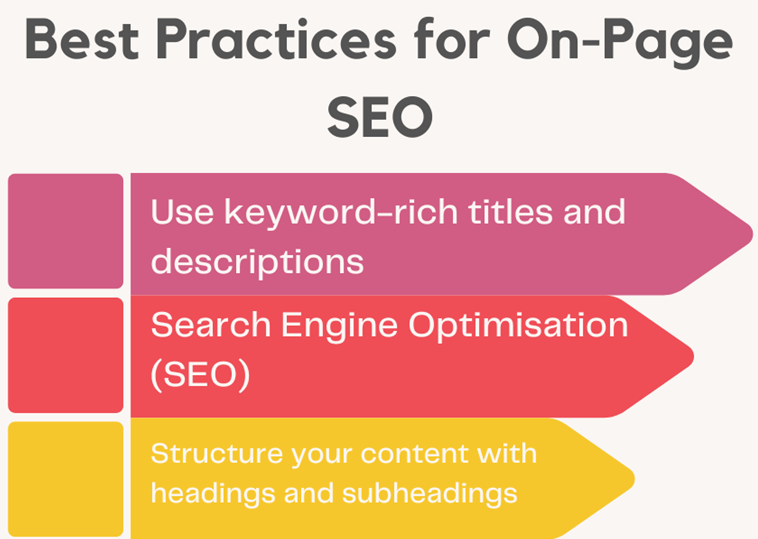
Here are the best practices for on-page SEO in 2023:
- Use keyword-rich titles and descriptions
When optimizing your website for the search engines, it’s important to use keyword-rich titles and descriptions. This will help your website rank higher in the search results for those keywords.
- Optimize your content for voice search
Voice search is becoming more and more popular, so it’s important to optimize your content for voice search. This means using natural language and long-tail keywords.
- Structure your content with headings and subheadings
Another important tip for on-page SEO is to structure your content with headings and subheadings. This makes it easier for users (and search engine crawlers) to read and understand your content. Plus, it helps improve your website’s CTR.
Know More About Keyword Research
Optimizing Title Tags and Meta Descriptions
When it comes to on-page SEO, one of the most important elements to focus on is your title tags and meta descriptions. These are what show up in the search engine results pages (SERPs), so it’s crucial that they’re optimized in order to stand out from the competition and entice people to click through to your website.
Here are some tips for optimizing your title tags and meta descriptions:
- Keep your titles under 60 characters.
- Include keywords that are relevant to your content.
- Make your meta descriptions interesting and informative, but also keep them under 160 characters.
- Use rich snippets to enhance your SERP listings and make them more eye-catching.
- Test different versions of your title tags and meta descriptions to see what works best.
By following these tips, you can ensure that your title tags and meta descriptions are working hard for you and helping you attract more traffic to your website!
Structuring Your URLs
When it comes to on-page SEO, one of the most important elements is your URL structure. Having a well-organized URL can help search engines index and crawl your site more effectively, and it can also help users navigate your site more easily.
Here are some tips for structuring your URLs:
- Use keyword-rich URLs: Include relevant keywords in your URLs to help improve your site’s search engine ranking.
- Keep URLs short and easy to remember: Long and complex URLs are often difficult for users to remember, and they can also be more difficult for search engines to index. Try to keep your URLs as short and concise as possible.
- Use hyphens to separate words in your URL: Using hyphens between words in your URL helps improve readability and makes it easier for search engines to index your content.
- Avoid using dynamic parameters in your URL: Dynamic parameters can make it more difficult for search engines to index your content, so try to avoid using them if possible. If you must use dynamic parameters, make sure to include them in your robots.txt file so that search engines know how to crawl them correctly.
- Use canonical tags when needed: If you have multiple pages with similar content, you can use canonical tags to tell search engines which page is the original source of that content. This helps prevent duplicate content issues and can improve your site’s search engine ranking.
Utilizing Header Tags
Header tags, or H1-H6 tags, are one of the most important on-page SEO elements. They are used to indicate the hierarchy of your content, with H1 tags being the most important. H1 tags should be used for your main headlines, while H2 tags can be used for subheadings. H3-H6 tags can be used for further subheadings or secondary information.
Search engines use header tags to help determine the topic of your page and how it relates to other content on the web. That’s why it’s important to use them effectively. Here are some tips for using header tags:
– Use only one H1 tag per page. This tag should be used for your main headline.
– Use H2-H6tags for subheadings and secondary information.
– Make sure your headlines and subheadings are relevant to the rest of your content.
– Keep your headlines and subheadings short and concise.
– Use keyword-rich phrases in your headlines and subheadings to help improve your SEO
Writing Compelling Content
Compelling content is the bread and butter of on-page SEO. Not only does great content help to improve your search engine rankings, but it also helps to keep visitors on your site longer and encourages them to convert.
So, what makes for compelling content? In general, it should be well-written, informative, and relevant to your target audience. It should also be keyword-rich, without being too keyword-stuffed. And, of course, it should be unique – not something that’s been copied and pasted from another site.
To really make your content stand out, try to focus on creating evergreen content – pieces that will remain relevant and useful for months or even years to come. This type of content can be difficult to produce, but it’s worth the effort as it will continue to drive traffic to your site long after it’s been published.
Image Optimization
Image optimization is one of the most important on-page SEO best practices. By optimizing your images, you can improve your website’s load time, which can positively impact your search engine rankings. In addition, by using descriptive file names and alt text, you can help improve your website’s usability and accessibility, which are both important ranking factors.
Internal Linking Strategies
When it comes to on-page SEO, one of the best things you can do is focus on your internal linking strategy. By linking to other pages on your website, you can help search engines understand your site structure and improve your overall ranking.
Here are a few tips for improving your internal linking:
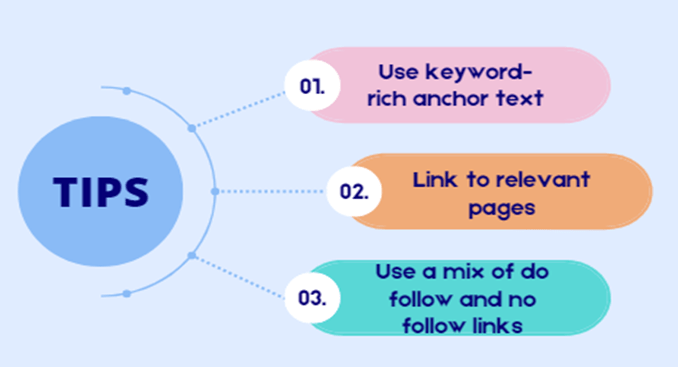
1. Use keyword-rich anchor text: When linking to other pages on your site, be sure to use keywords in your anchor text. This will help search engines understand what the linked page is about and could potentially improve your ranking for those keywords.
2. Link to relevant pages: Only link to pages that are relevant to the content on the page you’re linking from. Search engines penalize sites that link to unrelated content, so it’s important to be mindful of the context of each link.
3. Use a mix of do follow and no follow links: A mix of do follow and no follow links is generally recommended as it helps create a more natural link profile. However, there’s no need to worry too much about this – just focus on creating quality content and links, and the rest will fall into place.
Ensuring Website Performance
To ensure your website is performing at its best, there are a few key on-page SEO best practices to follow.
First, make sure your website is fast and responsive. Users expect websites to load quickly, so if yours is slow, they’re likely to leave. Use Google’s PageSpeed Insights tool to test your site speed and get recommendations for improvement.
Second, optimize your website for all devices. More and more users are accessing the internet from their mobile devices, so it’s important that your website is optimized for them. This means having a responsive design that looks good on all screen sizes and making sure your content is easy to read on a smaller screen.
Third, pay attention to your website’s structure. Your website’s hierarchy should be easy to understand, with a clear navigation bar that allows users to find what they’re looking for easily. Pay attention to the organization of your content and make sure it flows well.
Don’t forget about technical SEO. This includes things like using the correct keyword density in your content, using proper tag hierarchy, and creating descriptive title tags and meta descriptions. While these may seem like small details, they can make a big difference in how search engines index and rank your website.
Testing and Tracking Results
As digital marketers, we are always looking for ways to improve our on-page SEO. After all, optimizing our website’s pages is one of the most effective ways to improve our search engine rankings and drive organic traffic.
But with so many on-page SEO factors to consider, it can be difficult to know where to start. That’s why we’ve put together this list of on-page SEO best practices. By following these tips, you can be sure that your pages are optimized for both search engines and your target audience.
1. Testing and Tracking Results
One of the most important aspects of on-page SEO is testing and tracking your results. After all, what works for one website might not work for another. And what works today might not work tomorrow.
That’s why it’s important to constantly test different on-page SEO tactics on your own website. Then, track your results using Google Analytics or other tools. This will help you determine which tactics are working and which ones aren’t.
2. Use Keywords Strategically
Of course, you want to use relevant keywords on your website if you want to rank well in search engines. But it’s not enough to just stuff your keywords into your content randomly. You need to use them strategically if you want them to actually benefit your website.
Conclusion:
On-page SEO is an essential part of any website’s success in the digital world. As Google and other search engines continue to evolve, it is important for businesses to stay on top of trends and best practices. By following the tips outlined in this article, you can ensure that your website remains optimized for search engine rankings well into 2023 and beyond. Taking advantage of these strategies now will help you get a head start over your competitors who are still playing catch-up with their SEO efforts.
4, Oct 2023
The ABCs of SEO: An Essential Beginner’s Guide
Welcome to the exciting world of SEO! Whether you’re a small business owner, a content creator, or simply someone curious about improving their online presence, this beginner’s guide is your key to unlocking the secrets of Search Engine Optimization.
In today’s digital age, understanding the ABCs of SEO has never been more crucial for standing out in the virtual crowd and driving organic traffic to your website.
So grab your learning caps and get ready to delve into this essential guide that will empower you with all the knowledge you need to conquer search engine rankings and elevate your online success. Let’s embark on this journey together as we demystify the world of SEO one letter at a time!
What is SEO?
Search engine optimization (SEO) is the practice of improving the ranking of a website on search engines. The higher the ranking, the more likely people are to find the website.
There are a number of factors that contribute to a website’s ranking on search engines, including the quality and quantity of the website’s content, the number of incoming links to the website, and the website’s overall popularity.
SEO is an important tool for anyone who wants to increase traffic to their website. By improving their website’s ranking on search engines, they can make it easier for people to find their site and, ultimately, increase their business.
Basics of SEO and how it works:
SEO is short for “Search Engine Optimization”. It is a long-term marketing strategy employed in order to improve a websites visibility and organic search results in google and other global search engines.
SEO works by optimizing a website for google’s ever-changing algorithms. Google uses these algorithms to decide which websites should be displayed on the first page of their search engine results pages (SERPs).
To optimize your website, you need to understand how these algorithms work and make sure your website meets all of the criteria they are looking for. This can be a difficult and time-consuming task, which is why many businesses hire SEO specialists or agencies to do it for them.
Different types of SEO tactics:
There are a number of different types of SEO tactics that you can use to improve your website’s ranking in search engines. Some of the most common and effective SEO tactics include:
Keyword research –
Identifying the right keywords to target is one of the most important aspects of successful SEO. You need to identify keywords that are relevant to your business and that have a high search volume but low competition.
On-page optimization –
Once you’ve identified the right keywords, you need to make sure that your website is optimized for those keywords. This includes optimizing your title tags, meta descriptions, header tags, and content for the target keywords.
Link building –
One of the most important ranking factors for any website is the number and quality of links pointing to it. You can improve your website’s link popularity by actively pursuing link opportunities and building high-quality backlinks from relevant websites.
Social media marketing –
Social media can be a great way to promote your website and its content. Creating social media profiles on popular sites like Facebook, Twitter, and Google+ can help increase your visibility online and attract more visitors to your website.
Pay-per-click advertising –
Paid advertising can be an effective way to get more traffic to your website in the short term. However, it’s important to ensure that your ads are targeted towards relevant keywords so that you don’t waste money on unqualified clicks.
On-Page vs. Off-Page SEO:
There are two types of SEO:
on-page and off-page. On-page SEO is the process of optimizing a website for search engines, with the goal of earning higher web traffic levels and improving the visibility of the site. Off-page SEO, on the other hand, refers to the efforts made outside of a website to improve its search engine rankings. The most common methods used in off-page SEO include link building and social media engagement.
Both on-page and off-page SEO are important for any website that wants to rank well in search engines. However, which one is more important depends on the individual website and its current situation. In general, though, it is recommended that website owners focus on both types of SEO in order to achieve the best results.
Keyword Research & Analysis Strategies:
When it comes to SEO, keyword research and analysis is essential. There are a number of strategies you can use to ensure you are targeting the right keywords for your website and getting the most out of your SEO efforts.
One strategy is to use keyword research tools like Google AdWords Keyword Planner and Moz Keyword Explorer. These tools will help you to identify relevant keywords for your website based on search volume and competition.
Another strategy is to use competitor analysis. This involves looking at what keywords your competitors are targeting and how they are ranking for those keywords. This can give you insights into which keywords you should be targeting.
It is also important to keep an eye on your website’s search engine rankings. This will give you an indication of how well your SEO efforts are paying off and which keywords are driving traffic to your site.
Technical SEO & Website Optimization:
Technical SEO is the process of optimizing a website for Google’s search algorithm. It involves improving the site’s code, structure, and overall speed and performance. Technical SEO is a complex and ever-evolving field, but there are some essential basics that all website owners should know.
To start, make sure your site is well-coded and free of errors. This will help Google index your site correctly and improve its crawling speed. Next, focus on improving your site’s structure and organization. Use clear, descriptive titles and headings to help Google understand your content. Work on speeding up your site. A fast loading website will improve your user experience and rankings in Google’s search results.
By following these basic technical SEO tips, you can improve your website’s visibility and draw more traffic from Google’s search engine. For more detailed information on technical SEO, check out our comprehensive guide below.
Link Building & Content Strategies:
In order to rank higher on search engine results pages (SERPs), your website needs links from other websites. Link building is the process of acquiring these links.
There are many different ways to build links, but some methods are more effective than others. Some common link building strategies include:
• Creating informative or entertaining content that other websites will want to link to
• Creating helpful resources such as infographics or how-to guides that other websites will want to link to
• Participating in forums or online communities and providing helpful responses that include a link back to your website
• Reaching out to bloggers or influencers in your industry and asking them to mention your website in their next blog post or social media update
Local SEO Tactics
If you’re running a local business, you need to make sure your website is optimized for local search. Here are some tactics you can use to make sure your site comes up in relevant local searches:
-Make sure your NAP (name, address, and phone number) is consistent across all your listings and on your website.
-Claim and verify your Google My Business listing.
-Optimize your website for relevant keywords.
-Build citations from high-quality directories.
-Encourage customer reviews and testimonials.
Creating an Effective SEO Strategy:
Any business with an online presence needs to invest in SEO. Search Engine Optimization ensures that your website is visible to people who are searching for the products or services you offer. An effective SEO strategy will help you to rank higher in search engine results pages, and attract more organic traffic to your website.
To create an effective SEO strategy, you need to understand how search engines work and what factors they use to rank websites. Keyword research is essential for understanding which terms people are searching for, and how difficult it will be to rank for those keywords. Once you have targeted a few key phrases, you can start optimizing your website content and structure to make it more search engine friendly.
Building links from other websites is another important part of SEO. Link popularity is one of the main factors that search engines use to rank websites. The more high quality links you have pointing to your website, the higher your site will rank. Guest blogging on other sites, directories, and forums can also help increase your link popularity.
SEO is a complex and ever-changing field, but by following these basic principles you can get started on improving your website’s visibility in search engine results pages.
Conclusion:
SEO is an essential part of any website’s success. It can help to boost traffic, improve conversions, and increase visibility in the search engine rankings. With this ABCs of SEO guide, you now have a better understanding of the basics and are equipped with the knowledge needed to start optimizing your website for success. Remember: SEO takes time and dedication – but if done right it can make a real difference in terms of driving more organic traffic to your site. Good luck!
9, Mar 2023
Digital Marketing Services in India for Your Business Growth

Are you looking for ways to reach more customers and boost your online presence? Digital marketing services are the perfect solution. Digital marketing is the process of using various digital channels, such as search engines, social media, and email, to promote products or services and increase customer engagement. These services can help businesses build a strong presence in the digital world and reach more potential customers than ever before. In this blog post, we’ll explore the different types of digital marketing services in India available and how they can be used to maximize your reach. Read on to learn more about what digital marketing can do for your business.
What is digital marketing?
Digital marketing is any marketing that takes place online. This can include things like search engine optimization (SEO), pay-per-click (PPC) advertising, social media marketing, email marketing, and more.
Most businesses today have some form of digital marketing, even if they don’t realize it. For example, if you have a website, that’s digital marketing. If you’re using social media to promote your business, that’s digital marketing too. And if you’re doing any kind of online advertising, well, you guessed it – that’s also digital marketing.
Digital marketing in India is essential for any business that wants to be successful in the modern world. With so much of the population online and interacting with businesses through the internet, there’s just no other way to reach them. If you’re not doing digital marketing, you’re missing out on a huge opportunity to connect with your target audience and grow your business.
The different types of digital marketing services in India
Digital marketing services in India can be broadly divided into three categories: online marketing, offline marketing, and integrated marketing.
Online marketing refers to any form of marketing that is conducted online through the use of digital channels such as search engines, websites, social media, email, and mobile apps. Offline marketing, on the other hand, refers to traditional marketing techniques that are not conducted online, such as TV commercials, print ads, billboards, and direct mail.
Integrated marketing is a term that is used to describe a holistic approach to marketing that combines both online and offline tactics in order to reach the widest possible audience.
Digital marketing services in India can help businesses reach their target audiences more effectively and efficiently than ever before. By utilizing the power of digital technology and the internet, businesses can connect with their customers in new and innovative ways. Whether you’re looking for help with your website, social media, or general online presence, there’s a digital marketing service out there that can fit your needs.

Pros and cons of digital marketing services in India
Digital marketing services are a great way to reach out to potential customers and promote your business. However, there are some pros and cons that you should consider before investing in digital marketing services.
Pros:
-You can target a large audience with digital marketing services.
-Digital marketing services can be very cost-effective.
-Digital marketing services are flexible and can be customized to your specific needs.
-You can track the results of your digital marketing campaigns, so you know what is working and what isn’t.
Cons:
Digital marketing services can be time-consuming to manage.
-It can be difficult to stand out from the competition with digital marketing.
-You need to have a good understanding of technology to use digital marketing effectively.
What to look for in a digital marketing service provider
When looking for a digital marketing service provider, it is important to consider the following factors:
- The provider’s level of experience and expertise Make sure to choose a provider with a proven track record in the digital marketing field.
- The provider’s ability to create and implement an effective digital marketing strategy that aligns with your business goals.
- The provider’s use of data and analytics to drive results Choose a provider that uses data-driven insights to inform their work and help you achieve your desired outcomes.
- The provider’s creativity and innovation. Look for a provider that is constantly exploring new ways to reach and engage your target audience.
- The provider’s commitment to customer service Make sure the provider you choose is responsive to your needs and committed to delivering high-quality results.
How to choose the right digital marketing service provider
Digital marketing is a big umbrella that incorporates a variety of different services. To get the most out of your digital marketing campaigns, you need to choose a service provider that can offer you the specific services you need to reach your target audience. Here are some things to keep in mind when choosing a digital marketing service provider:
- Services: What services does the provider offer? Make sure they offer the services you need, such as SEO, social media marketing, email marketing, etc.
- Experience: How long has the provider been in business? Do they have experience working with businesses in your industry?
- Clientele: Who are some of the provider’s past and present clients? Are they happy with the results they’ve seen?
- Credentials: Does the provider have any industry-recognized credentials? This can give you peace of mind knowing that you’re working with a reputable company.
Take your time to do your research and ask plenty of questions. Choose a digital marketing service provider that you feel confident will help you achieve your goals.
Conclusion
Digital marketing is quickly becoming one of the most important aspects of any business. With the right digital marketing services in India, you can reach new customers and increase brand awareness in no time. Finding a team that understands your goals and knows how to deliver results can be challenging, but well worth the effort in the long run. Hopefully, this article has given you an idea of what to look for when choosing a digital marketing service provider that will help your business succeed online.